

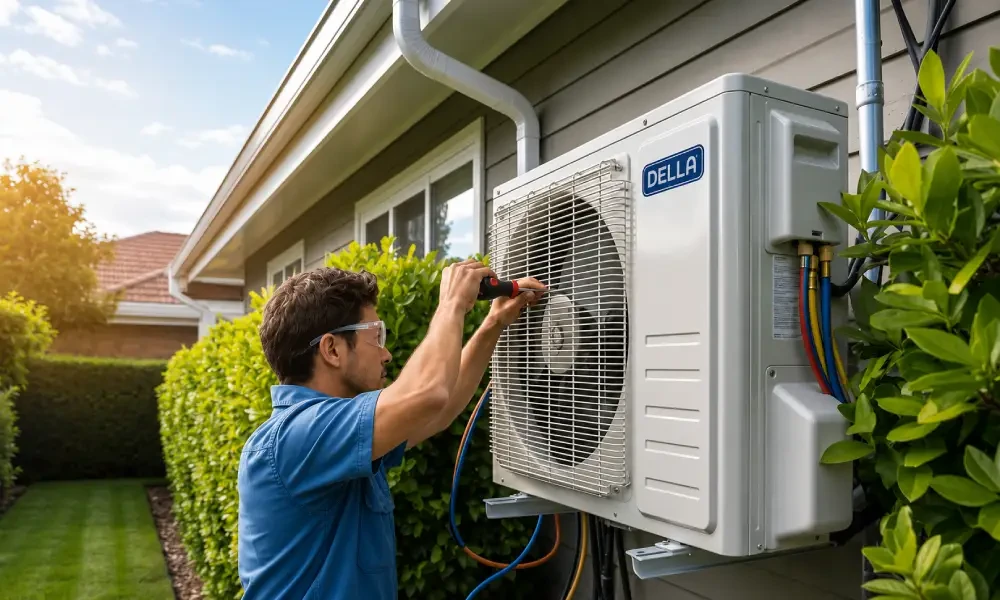
Eleven summers. That’s the number I keep coming back to. Most central air conditioners give you somewhere between ten and fifteen cooling seasons before the repair bills start stacking up faster than the thermostat climbs. The tricky part isn’t knowing the unit will die eventually. It’s knowing whether you’re looking at a bad capacitor or the last gasps of a compressor that’s been wheezing since 2016.
If you’re standing in a 78 degree living room in July with a unit that won’t keep up, you need a straight answer, not a sales pitch. Below is how I’d walk through the decision myself: the symptoms that mean “fix it,” the symptoms that mean “start pricing a replacement,” and the math that settles the argument when your gut and your checkbook disagree.
Start With the Age, Not the Symptom
Before you call anyone, look at the data plate on the outdoor condenser. The manufacture date is usually stamped right on it. That single number reframes everything else you’re about to observe.
Under 8 years old with a mechanical failure? You’re almost always repairing. Between 8 and 12? It depends on which component failed and how much you’ve already spent. Past 12, and you’re in the zone where a repair is really a down payment on a replacement you’ll be making in the next two summers anyway.
Here’s the stance I’d take: I would not put a $1,400 compressor replacement into a 13 year old system unless I had a specific reason to believe the rest of it was unusually healthy. The money buys you maybe three seasons. Spread that same spend across a new system and you get fifteen.
Older units also run on older refrigerant. The Environmental Protection Agency oversees the phaseout of refrigerants with high global warming potential, and that shift has made servicing some legacy systems both harder and pricier as the older gas becomes scarce. Worth knowing before you assume a repair quote is unreasonable. It might just be the refrigerant.
Six Symptoms That Point Toward Replacement
None of these are conclusive on their own. Two or three together, though, and the picture gets clear.
- It runs constantly but never hits the setpoint. A system that can’t cool the house on a 90 degree afternoon is telling you the compressor is losing capacity.
- Rising electric bills with no change in habits. Failing compressors draw more current for less cooling. Your utility statement is honestly one of the best diagnostic tools you own.
- R-22 refrigerant top-offs. If your tech has added charge twice in three years, you have a leak. Sealed systems don’t consume refrigerant.
- Uneven rooms. Upstairs is a sauna, downstairs is fine. That can be ductwork, but on an aging system it often signals declining blower performance.
- Rattling, grinding, or a compressor that startles you. Some noise is normal. Metal on metal is not.
- Yellowish staining around the indoor coil or a musty smell. Refrigerant oil residue near the coil housing points to a leak you’ll be chasing for years.
You can run the numbers yourself using the Energy Department’s guidance on cooling costs and equipment efficiency. It’s not glamorous reading, but it beats guessing at whether the bill is normal.
Why the “Half the Cost” Rule Still Works
The rule of thumb most technicians use: if the repair costs more than half the price of a new system, and your unit is past the eight year mark, replace it. I’ve watched this rule hold up across enough jobs to trust it. It’s crude. It’s also right more often than it’s wrong.
What makes it work is that it bundles two variables into one decision. You’re accounting for the cost of the fix, yes, but you’re also implicitly pricing in the remaining life of everything else in the system that didn’t break. Replace a blower motor on a 14 year old unit and the condenser fan is next, then the capacitor, then the coil.
So run the arithmetic honestly. Get the repair quote in writing. Get a replacement quote in writing. Divide. If the repair crosses half, you’ve got your answer.
A Framework I Use: The Five Point Reset
I call this the Five Point Reset because it resets the conversation from “what’s wrong today” to “what does the next decade look like.” Score your system on each point, one point per yes.
- Is the unit more than 10 years old?
- Have you paid for two or more repairs in the last three years?
- Is it using phased-out refrigerant?
- Are your summer electric bills climbing while comfort drops?
- Would a repair exceed half the cost of a new system?
Zero or one point: repair and keep going. Two or three: get quotes, plan for next spring. Four or five: start making calls this week, before you’re doing it on the hottest day of August with a house full of people.
That last point matters more than people expect. When you replace on your own schedule, you’re comparing options. When you replace because the house hit 85 degrees at 4 p.m. on a Saturday, you’re taking whatever’s available.
What Actually Changes When You Replace
A new system isn’t just a working version of the old one. Modern equipment runs at higher efficiency ratings, and proper installation matters more than the box the unit came in. The Air Conditioning Contractors of America publishes the load calculation and installation standards that good contractors follow, and a system sized by guesswork will underperform no matter how efficient the equipment is.
Ask any contractor you talk to three questions. Did you do a Manual J load calculation, or did you match the old tonnage? Will you verify airflow after installation? What happens if the system doesn’t hit the design temperature on a hot day?
Vague answers are your signal to keep calling. In my experience, the contractor who wants to talk about ductwork before talking about equipment is the one worth hiring.
What It Costs and What You Can Actually Control
You can’t set the price of a system. You can influence what you pay for it.
Schedule in spring or fall. Ask about available utility rebates for high efficiency equipment. Get three quotes, and make sure each one is quoting the same efficiency tier, because comparing a base model against a premium unit is how people talk themselves into overspending. Check whether the quote includes a new line set, a pad, a disconnect, and permit fees. Those add up.
And if you’re in south central Pennsylvania dealing with older housing stock and hard temperature swings, it’s worth talking to a company that does air conditioner replacement in Lancaster County homeowners actually keep on their short list, because a replacement is only as good as the crew doing the changeout.
One more thing worth saying plainly: don’t replace a system just because it’s old. Replace it because the evidence says the next repair is the wrong investment. Age opens the question. Symptoms and math answer it.
Before You Sign Anything
Write down the model number and efficiency rating of what’s being quoted. Ask for the warranty terms in writing, both parts and labor, because a ten year parts warranty with a one year labor warranty is a very different offer than it sounds. Confirm the permit is included. Confirm the old unit and refrigerant are being disposed of properly.
Then sleep on it. Nobody has ever regretted waiting one night to read a contract carefully. Plenty of people have regretted signing one in a hot kitchen.
If your system is throwing two or three of these signals, the useful move isn’t to panic. It’s to start gathering quotes while the current unit is still limping along, so the decision belongs to you instead of to the weather.
