

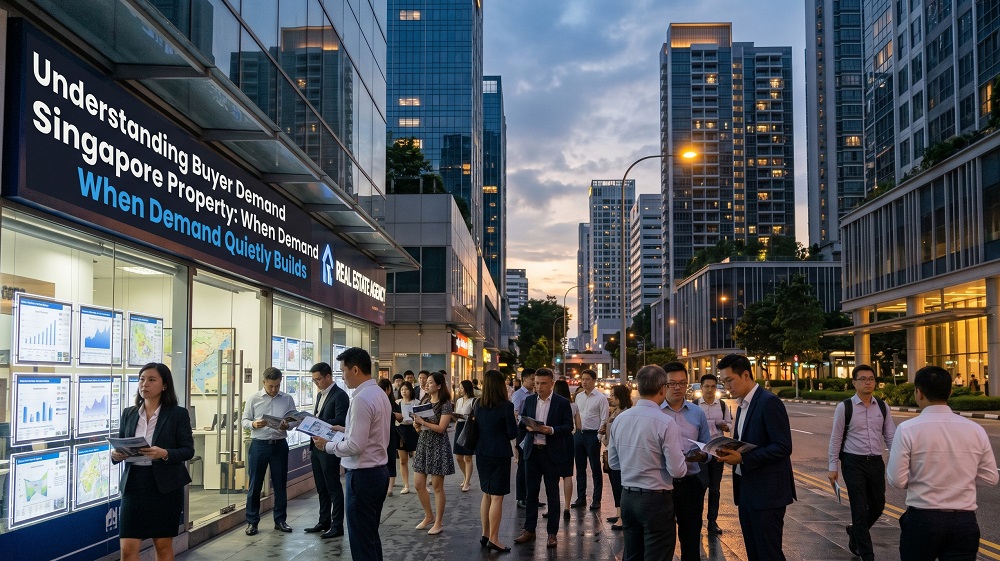
In Singapore’s property market, demand rarely moves in a straight line. It builds, pauses, and accelerates in cycles that are often subtle in the short term but very powerful over longer periods. For investors, recognizing these demand cycles is just as important as understanding prices or interest rates.
The challenge is that demand shifts are not always obvious in real time—they often become clear only in hindsight.
Demand Is Driven by More Than Just Prices
While price is an important factor, buyer demand in Singapore is influenced by a wider set of conditions:
- Interest rates and financing conditions
- Employment and income stability
- Government policy and cooling measures
- Supply pipeline in specific districts
- Lifestyle trends and migration patterns
When these factors align, demand strengthens. When they diverge, demand slows.
The Lag Between Sentiment and Reality
One of the most important characteristics of demand cycles is the delay between sentiment and actual transaction activity.
Often:
- Sentiment improves first
- Viewing activity increases next
- Transactions follow later
- Prices adjust last
This lag creates opportunities for investors who can recognize early shifts in behavior rather than waiting for price confirmation.
Accumulation Phases: Quiet but Important
Before strong price movements occur, markets often go through accumulation phases. These are periods where demand slowly builds without dramatic price changes.
Characteristics include:
- Stable or slightly rising prices
- Increasing buyer inquiries
- Gradual reduction in available listings
- Longer decision cycles among buyers
These phases are often overlooked because they lack excitement, but they set the foundation for future movement.
How Supply and Demand Interact
Demand cycles do not exist in isolation—they interact directly with supply conditions.
When supply is limited and demand rises, prices tend to strengthen faster. When supply increases during weak demand, the market may stagnate.
This is why understanding upcoming developments is critical. Areas with controlled or balanced supply often experience healthier demand cycles.
Location-Specific Demand Behavior
Not all parts of Singapore move in sync. Different districts experience different demand cycles depending on their characteristics.
- Central areas tend to have more stable demand
- City-fringe areas may experience stronger cyclical swings
- Emerging areas often see delayed but sharper demand growth
For example, developments like Thomson Reserve are influenced by both established neighborhood demand and gradual infrastructure enhancement, creating a more stable demand profile over time.
Lifestyle Trends as a Demand Catalyst
Modern buyer demand is increasingly influenced by lifestyle considerations. This includes:
- Walkability
- Food and entertainment options
- Green spaces
- Community environment
Areas that support these preferences tend to experience stronger and more consistent demand.
Developments such as Amberwood at Holland benefit from this trend, as lifestyle appeal helps sustain buyer interest even when broader market conditions soften.
The Role of Investor vs End-User Demand
Singapore’s property demand is a mix of end-users and investors, and the balance between them changes over time.
- End-users provide stability
- Investors add momentum during growth phases
When investor demand is strong, markets can accelerate quickly. When it weakens, markets tend to stabilize or slow.
Understanding which group is driving demand at any point in time is key to interpreting market behavior.
Psychological Cycles in Buyer Behavior
Demand is also shaped by psychology. Buyers tend to behave differently depending on market conditions:
- In rising markets: urgency increases, decision cycles shorten
- In stable markets: buyers become more selective
- In soft markets: hesitation increases, even when opportunities exist
These behavioral shifts create cyclical patterns in transaction volume.
Transaction Volume as a Leading Indicator
Price movements often lag behind changes in transaction volume. When volume increases consistently, it usually signals strengthening demand.
Conversely, declining volume may indicate weakening interest even if prices remain stable.
For investors, monitoring volume trends can provide early signals of demand shifts.
The “Invisible Demand” Effect
Some demand is not immediately visible in the market. Buyers may be waiting on the sidelines due to financing conditions, policy uncertainty, or timing preferences.
This creates “latent demand” that can re-enter the market quickly when conditions improve.
When this happens, sudden spikes in activity can occur even without major changes in supply.
Impact of Market Entry Timing
Entering during different demand phases can significantly affect outcomes:
- Early accumulation phase: slower but potentially stronger upside
- Peak demand phase: higher prices, lower upside
- Declining demand phase: better prices but slower recovery
Understanding where the market sits in this cycle helps refine entry strategy.
How Developers Respond to Demand Cycles
Developers closely monitor demand conditions and adjust pricing, launch timing, and marketing strategies accordingly.
In stronger demand phases, pricing tends to be more aggressive. In weaker phases, incentives or more flexible pricing structures may be introduced.
This responsiveness adds another layer of complexity to demand dynamics.
Final Perspective
Buyer demand in Singapore’s property market is cyclical, layered, and influenced by both economic and psychological factors. While it may appear stable on the surface, underlying shifts in behavior and sentiment constantly reshape the market.
Investors who understand demand cycles gain a clearer perspective on timing, positioning, and long-term strategy. Instead of reacting to price changes, they learn to interpret the forces that create those changes in the first place.
In a structured market like Singapore, recognizing demand patterns early can be the difference between following the market—and anticipating it.
